Here's what you need to know: An 833 vanity number is a fully legitimate, FCC-regulated toll-free number that works exactly like a 1-800 number. The difference? The 833 prefix was introduced in 2017 to expand the shrinking inventory of available toll-free numbers. For businesses, this means a critical advantage—more memorable vanity combinations are still available, numbers carry cleaner histories without previous owners, and costs are typically lower than premium 800 vanity numbers that have been recycled for decades.
This guide clarifies exactly what an 833 vanity number is, how it compares to legacy 800 numbers, and the step-by-step process any business or individual can follow to claim one.
Key Takeaways
- An 833 vanity number is a toll-free number spelling a custom word or phrase (e.g., 1-833-GET-HELP) instead of random digits—it functions identically to a 1-800 number
- The FCC introduced the 833 prefix on June 3, 2017, to expand the toll-free pool after earlier prefixes reached saturation
- 833 numbers offer more available vanity combinations, cleaner call histories, and lower costs than premium 800 alternatives
- Claim one by searching through a virtual phone provider, selecting your combination, and activating call forwarding — no physical hardware needed
What Is an 833 Vanity Number?
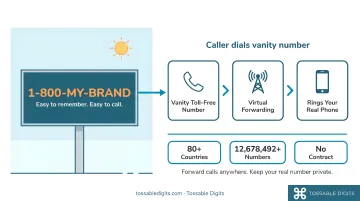
An 833 vanity number is a toll-free phone number where the last seven digits spell out a word, phrase, or brand name using the letters on a phone keypad. Instead of asking customers to remember 1-833-487-2391, your business can promote 1-833-GET-CASH—making it far easier for callers to recall and dial after seeing an ad.
The "toll-free" component means the business pays for each inbound call, not the caller. Anyone dialing from the US or Canada reaches your 833 number for free—so cost never stops a prospect from picking up the phone.
Where 833 Fits in the Toll-Free Family
The FCC introduced the 833 prefix on June 3, 2017, as the latest addition to the North American Numbering Plan (NANP) toll-free family. Here's the complete timeline of active toll-free prefixes:
| Prefix | Year Introduced | Status |
|---|---|---|
| 800 | 1967 | Active |
| 888 | 1996 | Active |
| 877 | 1998 | Active |
| 866 | 2000 | Active |
| 855 | 2010 | Active |
| 844 | 2013 | Active |
| 833 | 2017 | Active |
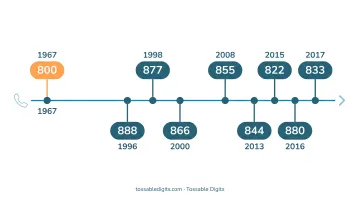
The sequential rollout reflects a simple reality: demand for toll-free numbers has outpaced supply, forcing the FCC to release new prefixes as older ones approach exhaustion.
The "Freshness" Advantage
Because 833 is the newest prefix, its numbers haven't been cycled through multiple past owners. That matters in practical ways:
- Fewer misdials from people trying to reach a previous business that held the number
- Less spam call history associated with the number
- Cleaner call analytics from day one—every inbound call is genuinely new
Legitimacy and Recognition
Those analytics advantages don't come at the cost of credibility. The 833 prefix is a fully recognized, FCC-regulated toll-free code—not a scam prefix, a lesser-tier option, or a regional number. Consumers across North America can call it for free, and businesses use it the same way they use 800. While consumer recognition of 833 is still building—70% recognize 888 as toll-free, 56% recognize 877, and 55% recognize 866—it works identically to every other toll-free prefix on every phone in North America.
833 vs. 800 Vanity Numbers: Key Differences
Functionally, 833 and 800 are identical. Both are toll-free, both work across the NANP, both can be used for vanity numbers, and neither costs the caller anything. The only difference is the three-digit prefix itself.
Availability: The Critical Distinction
The 800 prefix has been in use since 1967. By the time the 888 code was introduced in 1996, the original 800 prefix was approaching exhaustion. Today, the most memorable 800 vanity combinations—800-FLOWERS, 800-DENTIST, 800-LAWYERS—are long gone or carry recycled histories from previous businesses.
With 833, businesses have a realistic chance of securing a clean, meaningful combination that matches their brand or service. When the 833 prefix opened in 2017, demand was so intense that 17,638 "mutually exclusive" numbers were requested by multiple providers simultaneously, prompting the FCC to conduct an experimental competitive bidding auction. Despite that initial rush, millions of 833 numbers remain available through the standard first-come, first-served process.
The Recognition Factor
800 remains the most universally recognized toll-free prefix, with 94% consumer recognition. Yet consumers have grown accustomed to alternative prefixes over the years — the steady rollout of 888, 877, 866, 855, and 844 has normalized the idea of multiple toll-free codes.
Major government agencies and healthcare organizations already trust 833 for high-visibility campaigns:
- The U.S. Department of Health and Human Services uses 1-833-TLC-MAMA for the National Maternal Mental Health Hotline
- The State of Florida operates 833-GET-HOPE for emergency community assistance
These are not low-stakes deployments.
Benefits of an 833 Vanity Number for Your Business
Memorability and Advertising ROI
A word-based vanity number dramatically outperforms digit-only numbers in advertising recall. Nearly 85% of consumers report being more likely to remember a vanity number after seeing or hearing it in an advertisement, compared to numeric strings that evaporate from memory the moment an ad ends.
Radio, TV, and outdoor advertising benefit most. A billboard displaying 1-833-FIX-ROOF delivers a phrase callers can mentally rehearse during their commute. A string of random digits requires visual reference or immediate action—neither option is safe while driving.
Brand Building and Professionalism
A toll-free vanity number signals that your business is established, credible, and customer-focused. Even a solo entrepreneur can project national-level presence with the right number.
The psychological gap between "Call us at 203-555-7821" and "Call 1-833-GET-HELP" is real—the latter conveys scale, permanence, and genuine investment in customer accessibility.
Clean Tracking Data for Marketing Campaigns
Because 833 numbers are fresh, all inbound calls generated by a specific advertising campaign represent truly new leads. There are no legacy misdials from people trying to reach a previous business that held the number years ago. For marketers running attribution analysis, this means cleaner data and more accurate ROI calculations.
Geographic Flexibility
Unlike a local area code number, an 833 vanity number carries no regional implication. A business in Connecticut can market nationally without customers assuming they're calling a local shop. Calls can be forwarded anywhere—to your cell phone while traveling abroad, to a virtual phone line in a home office, or to a centralized call center across multiple states.
Privacy Protection for Individuals and Small Businesses
Virtual 833 vanity numbers allow professionals—real estate agents, freelancers, remote workers—to publish a business number without exposing their personal mobile number. This separation is critical for work-life balance and security, especially for professionals who advertise publicly but want to control when and how they're reachable.
How to Choose the Right 833 Vanity Number
Brainstorming Your Vanity Word or Phrase
Start with your business name, primary service, or a customer benefit. The best vanity numbers are short, action-oriented, and directly tied to what the business does:
- 1-833-FAST-HVAC (HVAC contractor)
- 1-833-GET-CASH (financial services)
- 1-833-NEW-ROOF (roofing company)
- 1-833-FIX-PIPE (plumbing service)
Before committing, verify how your chosen phrase maps on a phone keypad. The number 2 corresponds to ABC, 3 to DEF, 4 to GHI, and so on. Write it out digit-by-digit to ensure it's intuitive.
Check for Conflicts and Clarity
Say the number out loud multiple times. Does it sound natural? Are there awkward letter groupings or accidental alternate spellings? For example, 1-833-BUY-CARS could also be read as 1-833-BUZ-CARS, creating confusion.
Check trademark databases (such as the USPTO's TESS system) to ensure your chosen phrase doesn't conflict with an existing brand name. Using a competitor's trademarked phrase—even inadvertently—can lead to legal complications.
Secure Multiple Prefixes If Budget Allows
Established businesses that already own 800-BRAND should consider claiming the same phrase under 833 to prevent a competitor from using it. Newer businesses launching with 833 may want to lock down the same phrase across other available prefixes (844, 855, 866) as they grow — blocking competitors from claiming it and keeping your number recognizable no matter which toll-free code a customer dials.
How to Get an 833 Vanity Number: Step-by-Step
Step 1: Choose a Virtual Phone Number Provider
833 vanity numbers are available through FCC-registered toll-free service providers, also called Responsible Organizations (RespOrgs). You don't need to work with a major telecom carrier—virtual phone number providers offer the same access online with more flexible terms.
When evaluating providers, look for:
- No-contract plans with monthly billing
- Transparent pricing (no hidden setup fees or per-feature charges)
- All features included (call forwarding, voicemail, SMS)
- BBB accreditation or verified customer reviews
Tossable Digits is a BBB A+-rated provider offering toll-free numbers with every feature included in every plan and no contract required. Operating since 2005, the service has been featured in The Washington Post, The New York Times, CNET, Forbes, and the Today Show on NBC.
Step 2: Search for an Available 833 Vanity Combination
Use the provider's number search tool to enter the word or phrase you want and see what's available. Numbers are assigned on a first-come, first-served basis under FCC rule 47 CFR § 52.111, so if your first choice is taken, test variations:
- Different word order (1-833-ROOF-FIX instead of 1-833-FIX-ROOF)
- Abbreviations (1-833-GET-HELP vs. 1-833-GETHELP)
- Synonyms (1-833-FAST-LOAN vs. 1-833-QUICK-CASH)
Continue testing until you find an available match that meets your brand and memorability requirements.
Step 3: Activate and Configure Call Forwarding
Once you claim the number, set it to forward inbound calls to your existing phone—cell, landline, or virtual phone line. No new hardware is needed. The number is virtual, meaning it exists in software and routes calls to whatever device you specify.
Configure additional settings through your provider's dashboard or mobile app:
- Voicemail greeting (custom or pre-recorded)
- Business hours (send calls to voicemail outside operating hours)
- IVR/auto-attendant (route callers to departments or extensions)
- SMS capabilities (if your provider supports text on toll-free numbers)
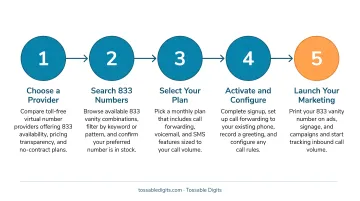
Step 4: Understand Pricing and Ownership
Typical pricing for toll-free numbers includes a monthly fee covering the number, features, and a set call minute allowance, with per-minute rates for overages. Baseline infrastructure costs from major providers range from $1 to $5 per month, though consumer-facing services bundle features into flat-rate plans.
Critical ownership question: Confirm you own the number and have full porting rights. Under FCC portability regulations, you have the legal right to move your toll-free number to a new provider at any time. This protects you from vendor lock-in and preserves every marketing asset tied to that number.
Step 5: Start Using It in Marketing
Once live, add the number to:
- Business cards and letterhead
- Website header and contact pages
- Social media profiles (Facebook, LinkedIn, Instagram)
- Email signatures
- Ad campaigns (Google Ads, Facebook Ads, radio, TV, outdoor)
You can also assign different numbers to different channels to measure performance. Use 1-833-BUY-CARS for radio and 1-833-NEW-CARS for billboards, then compare call volume to see which medium drives more business.
Frequently Asked Questions
How much does an 833 vanity number cost?
Costs vary by provider and typically bundle the number, call forwarding, and core features into a monthly fee. Baseline infrastructure pricing starts around $1 to $5 per month, while consumer-facing plans generally run $10 to $30 per month depending on included features and call allowances.
Is an 833 vanity number the same as an 800 number?
Yes, functionally they are identical. Both are toll-free, both work across the US and Canada under the NANP, and both cost the caller nothing. The only difference is the prefix itself—not the performance, routing, or legitimacy.
How can I tell if an 833 vanity number is legitimate?
All 833 numbers are FCC-regulated toll-free numbers. A legitimate 833 number will be associated with a real business or organization. If you receive an unsolicited call from an 833 number, look up the number online or ask the caller to identify the company before sharing personal information.
What happens if I answer an 833 vanity number?
Answering an 833 number is always free for the recipient — the number's owner pays for the call. If you own an 833 line, incoming calls route to whichever phone you've configured for forwarding: your cell, landline, or virtual phone line.
Can I use an 833 vanity number for texting?
Many virtual phone number providers support SMS on toll-free numbers including 833. Toll-free SMS is fully supported under FCC regulations, though text-enabling requires explicit authorization from the toll-free subscriber and compliance with carrier messaging standards. Confirm SMS availability with your provider before signing up.
Can I keep my 833 vanity number if I switch providers?
Yes. Toll-free numbers are portable under FCC rules. As long as you own your number (not just rent it), you can port it to a new provider without changing the number or losing any existing marketing materials. Most ports complete within a few business days.